“Industrial mixer” is not one kind of machine. A turbo mixer that heats PVC powder by friction to make dry blend and a ribbon mixer that gently blends dry mortar share a name, but they solve entirely different problems. The wrong type of mixer, however well built, will either heat a product that should stay cool or never reach the homogeneity the product needs. This guide outlines the main mixer types, how each one works and when it is the right choice, and ends with a comparison table.
Start with the product, not the machine
Before choosing a mixer type, describe how the product behaves. Four questions usually narrow the field considerably:
- Does it need heat? If additives must melt and be absorbed into the resin, as in PVC dry blend, you need a high-speed mixer. Products that must not warm up call for low-speed designs.
- Is it free-flowing or viscous? Free-flowing powders and granules need a different mixing action from paste-like products.
- Are the particles fragile? Brittle granules or metallic pigment flakes can be damaged by high shear.
- Is the goal production, trials or storage? Series production, formula development and keeping stored material in good condition each call for different machines.
Turbo mixer (heater–cooler mixer)
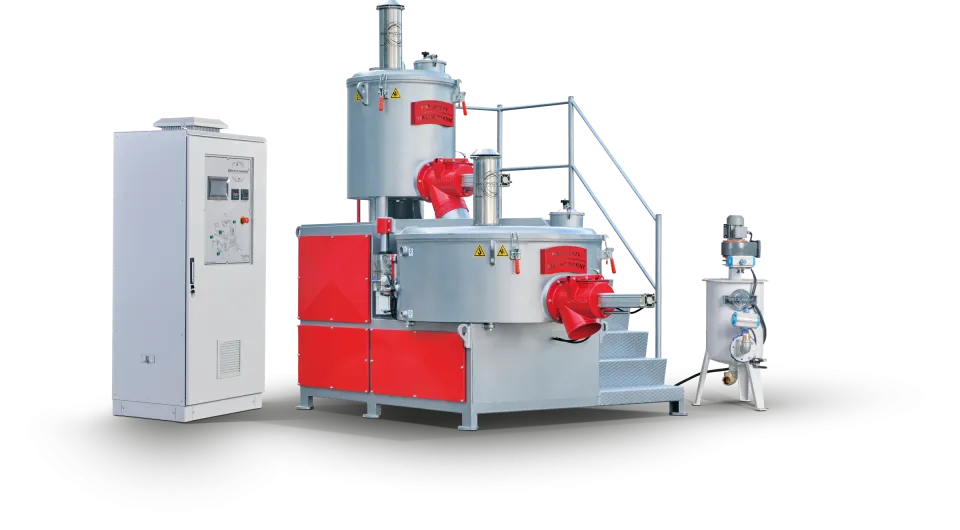
This is the type most people in the PVC industry mean when they say “mixer”. It is also called a hot/cold mixer or a high-speed mixer. High-speed blades in the heater vessel throw the powder into a vortex; as the blend heats up by friction, stabilisers and lubricants melt and are absorbed into the resin. For rigid PVC the batch is typically discharged at around 110–120 °C and brought down to roughly 40–50 °C in a jacketed cooling mixer. Most extrusion applications, including profiles, pipes, cable trunking, foil and WPC, rely on this arrangement.
There are two main designs depending on how the cooler is arranged: the horizontal-cooler turbo mixer (EPM-H, 150–500 kg per batch) and the vertical-cooler turbo mixer (EPM-V, 100–200 kg per batch). For the working principle see our article on how a heater–cooler mixer works, and for all models the heater–cooler mixers category.
Ribbon mixer
A shaft turns inside a horizontal U-shaped trough, usually carrying an inner and an outer helical ribbon. The ribbons move material in opposite directions, blending it both along the axis and radially. Tip speeds are low, so the product stays cool and fragile particles survive. Dry mortar, chemical powders, additive packages and granular products are typical applications. The ribbon mixer can be built in ST37, AISI 304 or AISI 316, with bottom or side discharge, and options such as a liquid spray system and side-mounted choppers.
Vertical silo mixer
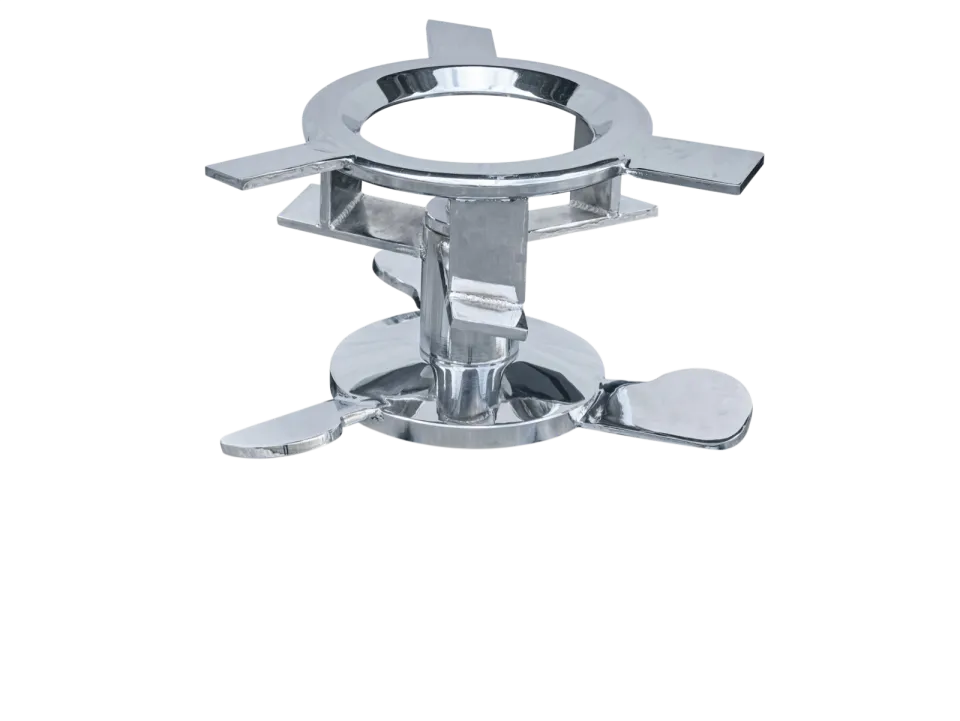
Powder held in a silo slowly compacts under its own weight and takes up moisture, and some formulations tend to cake by nature. A vertical mixer handles preparatory mixing before production and keeps material in the silo from caking because of humidity or formulation structure. It does not replace the main mixing step; it sends more consistent material to it. It can run continuously or at intervals and is sized to the silo it works in.
Planetary mixer
The mixing element spins on its own axis while also orbiting the centre of the vessel. That combined path sweeps the wall and centre zones that a blade on a fixed shaft can miss. It is chosen for viscous, pasty, dough-like and heavy products. A planetary mixer is configured per project around the product’s rheology and the required batch size, rather than taken from a standard table.
Metallic bonding mixer
A specialised mixer for fixing aluminium or bronze pigment flakes onto powder coating particles. Under controlled agitation the powder and pigment are brought close to the temperature at which the coating starts to soften, the flakes adhere to the particle surface, and the batch is then cooled. Too much heat causes lumps and too much mechanical force breaks the flakes, so it is a delicate process. See the metallic bonding mixer and the metallic powder coating bonding application page.
Laboratory mixer
A low-capacity turbo mixer working on the same principle as a production unit. A new stabiliser package, a different filler level or resin from another supplier can be trialled in small quantities without tying up the production line. The laboratory mixer is available with FV or SS drive; see the laboratory mixers category for more.
Comparison table
| Mixer type | Typical product and application | Mixing principle | Batch logic |
|---|---|---|---|
| Turbo (heater–cooler) | PVC dry blend: profiles, pipes, cable, foil, WPC | High speed, friction heating, jacketed cooling | Batch; discharge on temperature, 4–6 batches/h in the catalogue |
| Ribbon | Dry mortar, chemical powders, granules | Low speed, counter-flow helical ribbons | Batch; timed mixing, often followed by bagging |
| Vertical silo mixer | Powders and granules stored in silos | Keeps material moving in the silo, prevents caking | Continuous or intermittent; sized to the silo |
| Planetary | Viscous, pasty, heavy products | Tool rotates on its axis and orbits the vessel | Batch; configured per project |
| Metallic bonding | Metallic powder coatings | Controlled heating, pigment bonding, cooling | Batch; temperature control is critical |
| Laboratory | Formula trials, R&D, quality control | Same as a turbo mixer, at small scale | Small batches |
Ribbon, planetary and bonding mixers are grouped under special mixers.
Which one fits your process?
- Preparing dry blend for PVC extrusion? Start with a turbo mixer, and use the mixer capacity calculator to estimate batch size.
- Product must stay cool and flows freely? A ribbon mixer is usually the right starting point.
- The problem is caking in the silo, not mixing? Look at a vertical mixer together with moisture control.
- Paste or dough-like product? A planetary mixer may be the answer.
- Producing metallic powder coatings? The bonding process needs a dedicated mixer.
- Testing a new formula? Start small on a laboratory mixer.
For example lines by application, browse our applications, such as PVC door and window profiles or WPC wood–plastic composites.
Frequently asked questions
What is the main difference between a turbo mixer and a ribbon mixer?
A turbo mixer runs at high speed and generates heat by friction; it is designed for PVC blends whose additives need to melt. A ribbon mixer runs slowly and blends without heating the product.
Can one mixer handle several product types?
For products that behave similarly, yes; a turbo mixer with an FV drive can run different PVC formulas, for instance. Very different products, such as a heat-sensitive powder and PVC dry blend, usually need different mixer types.
What if I am not sure which mixer I need?
Share a description of the product, its bulk density, the batch size and whether heating or cooling is needed. Where useful, a laboratory-scale trial can show how the product behaves before you commit.