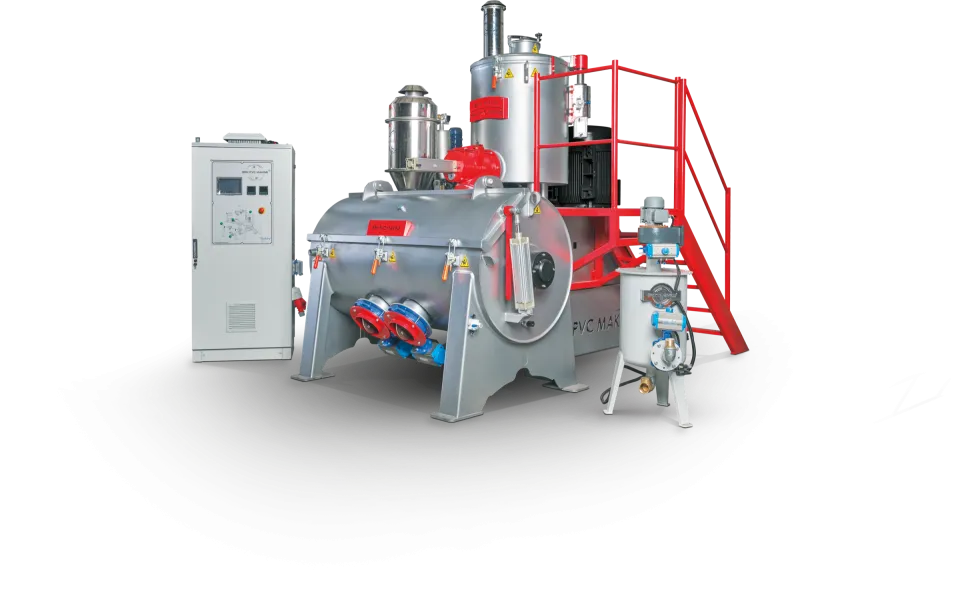
Walk into almost any plant that extrudes PVC profiles, pipes, sheet or cable compound and you will find the same pair of machines upstream of the extruder: a hot mixer and, below or beside it, a cooling mixer. Together they are called a heater–cooler mixer, though you will also hear hot/cold mixer, turbo mixer or high-speed mixer. Their job is to turn PVC resin powder and a list of additives into a homogeneous, free-flowing dry blend that the extruder can process consistently, batch after batch. This article walks through both stages, what happens inside the material at each step, and why one mixer on its own cannot do the job.
The hot mixer: heat from friction
The hot mixer is a vertical vessel with a high-speed impeller close to the bottom. Despite the name, the heat typically does not come from heating elements or a steam jacket. It comes from the impeller itself. The blades throw the powder into a vortex, and particles rubbing against each other, against the vessel wall and against the blades convert most of the motor’s power into heat. That is why hot mixers carry so much installed power relative to their volume. On Erk’s EPM-H series, heater vessels of 450–1250 litres are driven by 75–200 kW motors, with 110, 160, 200 and 250 kW available as options.
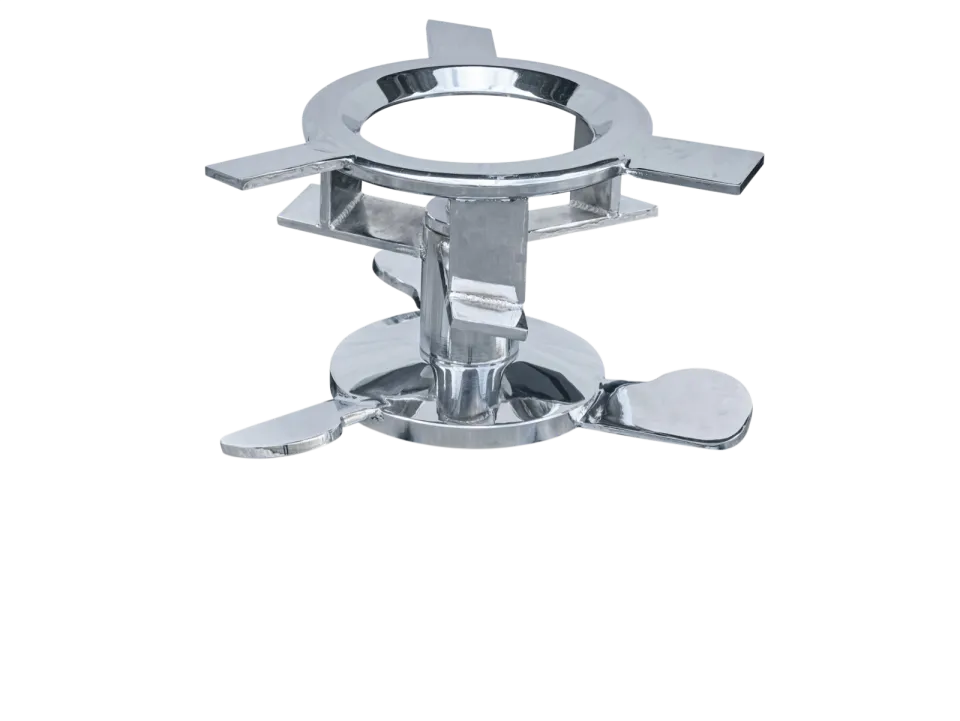
Blade geometry and tip speed govern how quickly the batch heats up and how evenly it circulates. Worn or badly angled blades lengthen the heating time and leave dead zones in the vessel, so blade condition is a maintenance item with a direct, measurable effect on cycle time.
How the additives get absorbed
As the temperature climbs, several things happen in sequence. In a typical rigid PVC formula the process runs roughly like this:
- Start: resin and stabiliser are loaded together; the particles are dry and porous.
- Lubricants melt: internal and external lubricants typically soften somewhere around 60–80 °C and begin to coat the resin grains.
- Absorption and densification: the grains swell slightly and their pores open, drawing molten and liquid additives inside. Bulk density rises and the blend starts to flow more freely.
- Fillers and modifiers: calcium carbonate, impact modifiers and processing aids go in at the stage the formula calls for and spread over the grain surfaces.
In flexible PVC the plasticiser is added during this phase and soaked up by the resin. Once absorption is complete, a blend that looked wet becomes dry and free-flowing again. Getting liquids in at the right moment and in the right amount matters, which is why Erk runs its liquid dosing in step with its powder dosing.
Discharge on temperature, not on time
A hot-mixer batch is usually discharged when it reaches a set temperature rather than after a fixed time. For rigid formulas the set point is typically in the 110–120 °C range; flexible compounds and some stabiliser systems run lower. Discharge too early and the additives may not be fully absorbed. Overshoot and you burn through stabiliser for no benefit while raising the risk of discolouration and lumps. When the discharge valve opens, the hot blend drops straight into the cooler.
The cooling mixer: why a second stage is essential
Dry blend at 110–120 °C cannot simply go into a silo or a bag. Held at that temperature it sticks, agglomerates and can partly gel under its own heat, and warm powder behaves unpredictably in conveying lines. The cooler keeps the material moving gently while water-jacketed walls pull the heat out, typically bringing the blend down to around 40–50 °C.
The cooling vessel is noticeably larger than the heater. Cooling is far slower than frictional heating: heat can only leave through material that is in contact with the jacketed surface, so the cooler needs a generous wall area and a longer residence time. Cooler volumes are 1000–3500 litres on the EPM-H series and 520–850 litres on the EPM-V series. The cooler impeller turns slowly. Its job is not to generate heat but to keep bringing fresh material to the cold wall.
How the two stages form one cycle
In a well-balanced system both vessels work at the same time: while the hot mixer heats a new batch, the cooler brings the previous one down. The longer of the two steps usually sets the cycle time. Erk’s catalogue figures for a standard PVC profile formula are 4–6 batches per hour, with 150–500 kg per batch on EPM-H and 100–200 kg per batch on EPM-V. These figures shift with the formula, and custom capacities can be engineered when needed. When the balance slips, cooling water, blade condition and raw-material moisture are the first things to check; our turbo mixer maintenance guide lists common symptoms, and PVC dry blend problems covers blend-quality issues.
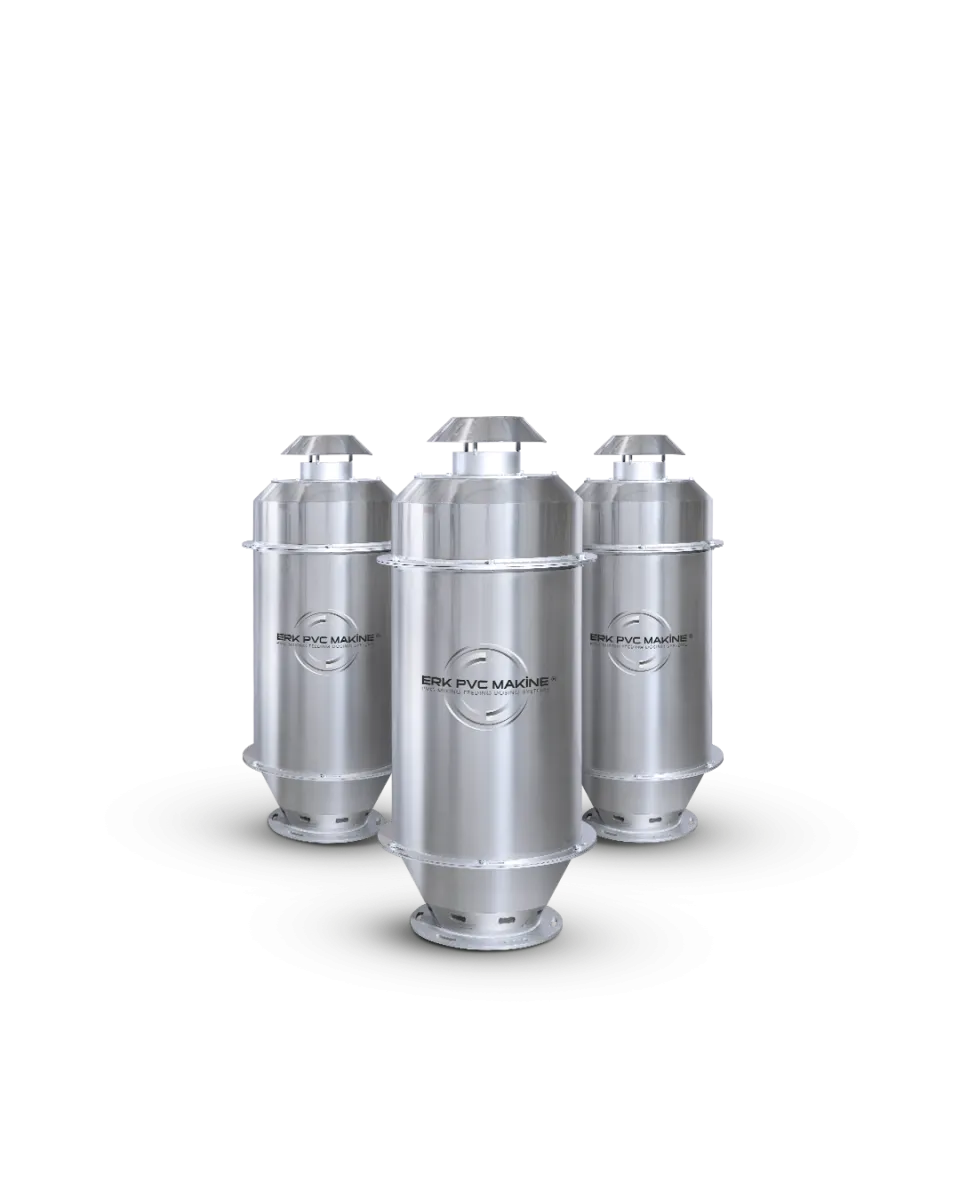
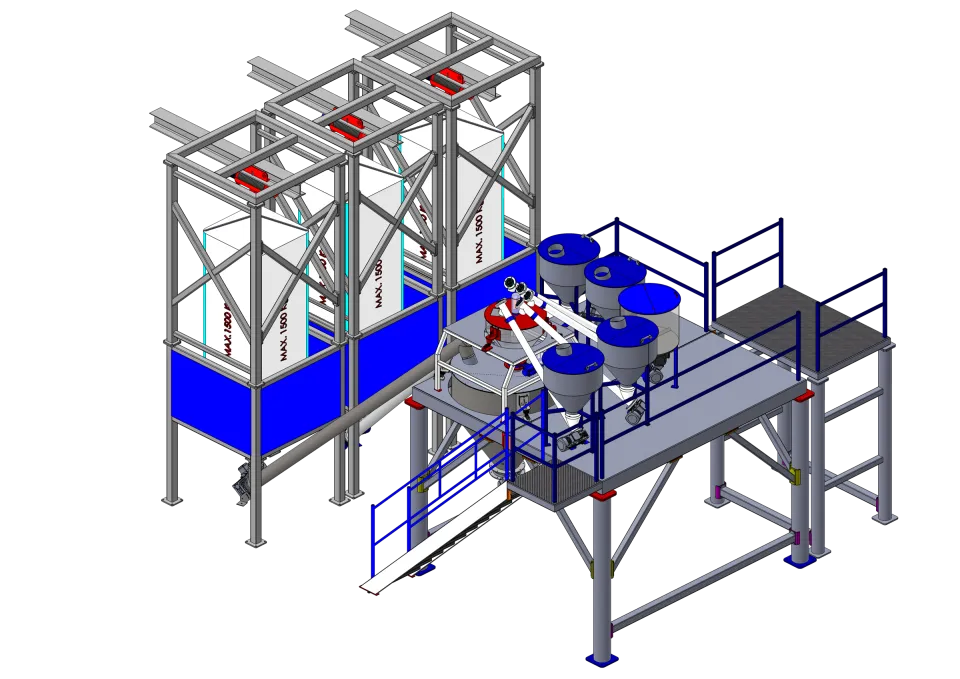
What happens before and after the mixer matters just as much. Automatic gravimetric powder dosing delivers raw materials in the right ratio, while flexible-spring, screw or pneumatic feeding systems carry the cooled blend to the extruders. A jet filter captures the vapour and dust released during the hot stage.
Next step
A heater–cooler mixer splits the work into frictional heating and jacketed cooling so that additives are fully absorbed and the blend leaves stable and ready to store. Which model and capacity suit your plant depends on your formula and how much your extruders consume. To see where the turbo mixer sits among other designs, read our industrial mixer types guide. Browse our heater–cooler mixers, then send your formula and throughput through the quote form and Erk’s engineers will review them with you.