The most common mistake in sizing a mixer is starting with the mixer. The right question is not “which mixer?” but “how much dry blend does my line consume per hour?” The mixer has to keep up with the extruders without interruption, and without running flat out all day to do it. Undersize it and the line waits for material. Oversize it and you pay for capacity and energy you do not use, while low fill levels can hurt blend quality. This article walks through the calculation from extruder output to batch size, using a clearly hypothetical example.
Step 1: Establish total demand
Start with the hourly output, in kg/h, of every extruder the mixer will feed. Use the rates the lines actually run at, or will run at in the near future, rather than the maximums printed in the extruder brochure. If one mixer serves several lines, add them up.
Then add a margin. Colour and formula changes, cleaning, maintenance stops, the occasional batch set aside for quality reasons and future growth all eat into the mixer’s theoretical capacity. How much margin is right varies from plant to plant; the percentages below are only there to illustrate the arithmetic.
Step 2: Batch size × batches per hour
For a batch-operated heater–cooler (hot/cold or high-speed) mixer, hourly capacity is a simple product:
Hourly capacity (kg/h) = batch size (kg/batch) × batches per hour
Erk’s catalogue figures, based on a standard PVC profile formula, are 150–500 kg per batch for the EPM-H series, 100–200 kg per batch for the EPM-V series, and 4–6 batches per hour for both. The number of batches per hour depends on how long your formula takes to heat and cool. Working from the low end, 4 batches per hour, rather than the high end gives you a safer basis for real production.
Multiplying the low and high catalogue values gives these theoretical ranges:
| Series | Batch size | 4 batches/h | 6 batches/h |
|---|---|---|---|
| EPM-V | 100–200 kg | 400–800 kg/h | 600–1200 kg/h |
| EPM-H | 150–500 kg | 600–2000 kg/h | 900–3000 kg/h |
Treat the table as a rough guide only; real numbers depend on the formula.
Step 3: A worked example
The figures below are purely illustrative and do not describe any particular plant. Assume a profile plant with three extruders fed from the same mixer:
- Extruder A: 250 kg/h
- Extruder B: 200 kg/h
- Extruder C: 150 kg/h
Total demand is 250 + 200 + 150 = 600 kg/h. With a 20% margin the target becomes 600 × 1.20 = 720 kg/h. Divide the target by batches per hour to get the batch size you need:
- At 4 batches/h: 720 ÷ 4 = 180 kg/batch
- At 5 batches/h: 720 ÷ 5 = 144 kg/batch
- At 6 batches/h: 720 ÷ 6 = 120 kg/batch
On the conservative 4-batch basis you need roughly 180 kg per batch, which lands in the 200 kg/batch class: 200 × 4 = 800 kg/h, comfortably above the 720 kg/h target. In that class both the EPM-V200 and the EPM-H200 are candidates, and the choice between them comes down to layout, growth plans and cooling requirements.
Now take a second hypothetical case: a single pipe line consuming 900 kg/h, with a 15% margin. That gives 900 × 1.15 = 1035 kg/h. At 4 batches per hour you need 1035 ÷ 4 ≈ 259 kg per batch. A 200 kg/batch mixer would reach only 1000 kg/h even at 5 batches per hour, which falls short. Here the 300 kg/batch class in the EPM-H series (300 × 4 = 1200 kg/h) is a more sensible starting point.
Step 4: Check volume and bulk density
Batch weight alone is not enough; the space the material occupies matters too. Apparent density of rigid PVC dry blend is typically taken as around 0.5 kg/L, the same reference value Erk gives for its laboratory mixer. On that basis a 200 kg batch occupies roughly 400 litres loose. The EPM-V200 has a 540 L heater and an 850 L cooler; the free volume above the material is what lets the vortex form and the powder circulate.
Highly filled formulas have a higher bulk density, so more kilograms fit in the same volume, but motor load and heating behaviour change with it. In flexible PVC, plasticiser absorption can lengthen the cycle. The same mixer can therefore deliver different hourly outputs on two different formulas.
Step 5: Account for everything else
- Cooling water: warmer cooling water means longer cooling and potentially fewer batches per hour, so size for your worst season.
- Drive: a frequency variator (FV) lets you adjust impeller speed for different formulas; a soft starter (SS) is the simpler option. The EPM-V150 and EPM-V200 are offered with SS only.
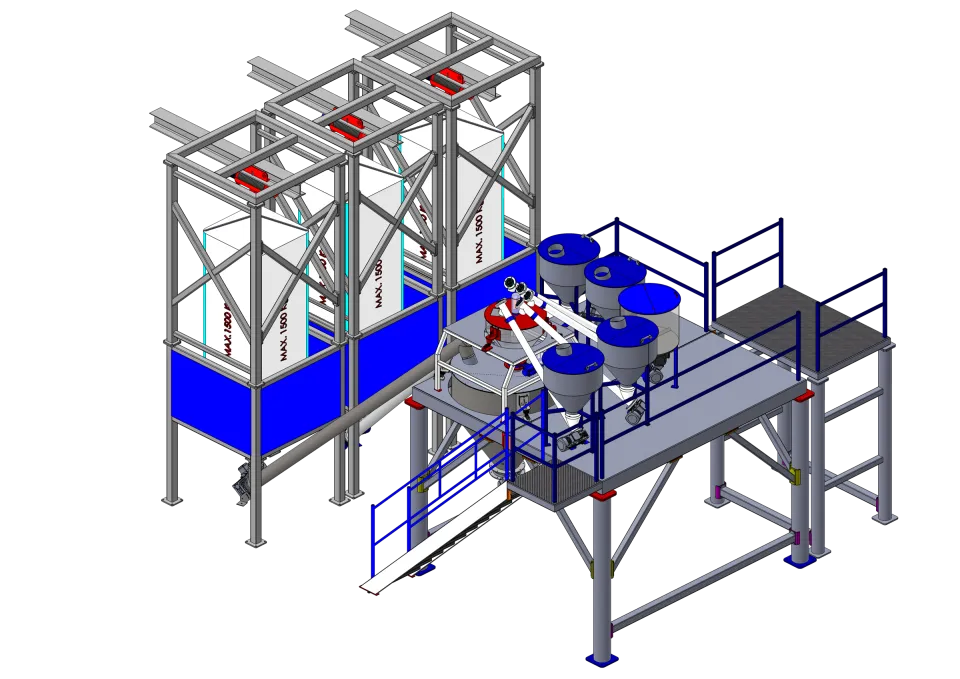
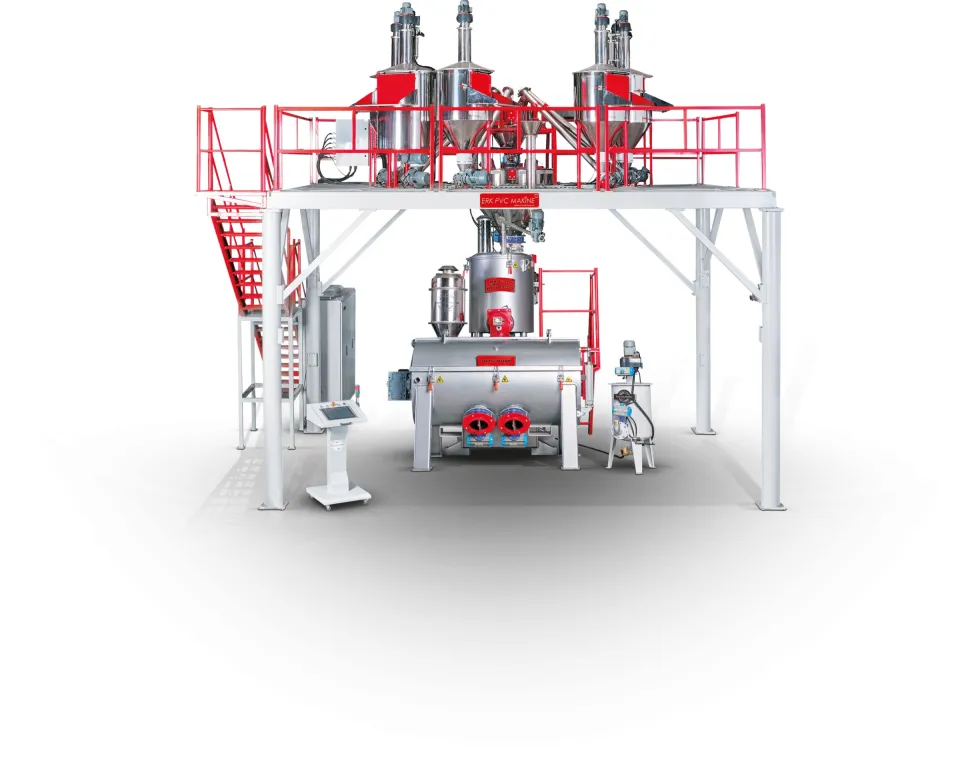
- Dosing and feeding: the mixer has to match the dosing system upstream and the conveying line downstream. An automatic powder dosing system must have each batch ready in time for the mixer’s cycle.
- Special requirements: where needs fall outside the standard range, Erk can design custom capacities.
Confirm the final size against your formula
The calculation above gets you to the right model class, but catalogue figures refer to a standard PVC profile formula and the answer moves when your formula does. Final sizing should be confirmed by Erk on the basis of your actual formula and operating conditions. To run the numbers with your own values, use the mixer capacity calculator. Send your extruder outputs, formula and growth plans through the quote form, and read our EPM-H vs EPM-V comparison for the differences between the two series. For how capacity feeds into investment, see what determines the price of a PVC mixer, and for sizing dosing and feeding along with the mixer, our turnkey PVC mixing line guide.