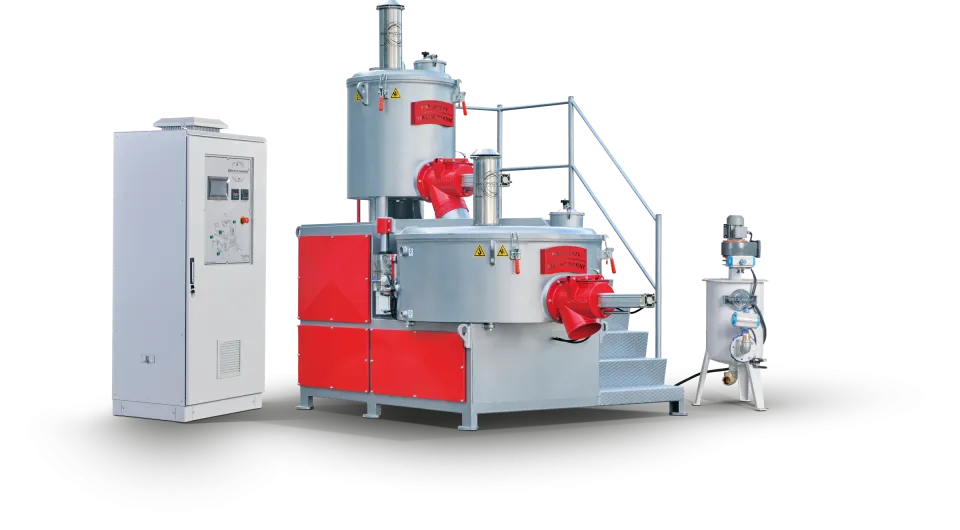
On a heater–cooler (hot/cold or turbo) mixer the hot side looks much the same in both designs: a vertical vessel with a high-speed impeller. The real difference is on the cooling side. Erk’s two series carry it in their names: the EPM-H has a horizontal cooler, the EPM-V a vertical one. This article compares the two on catalogue figures and looks at the general criteria that tend to drive the choice. The aim is not to declare a winner, but to help you work out which one suits your conditions.
The two series at a glance
| Feature | EPM-H (horizontal cooler) | EPM-V (vertical cooler) |
|---|---|---|
| Models | H150, H200, H300, H400, H500 | V100, V150, V200 |
| Batch capacity | 150–500 kg/batch | 100–200 kg/batch |
| Heater volume | 450–1250 L | 300 / 450 / 540 L |
| Cooler volume | 1000–3500 L | 520 / 700 / 850 L |
| Batches per hour | 4–6 | 4–6 |
| Drive | FV or SS | FV or SS (V150 and V200 SS only) |
All figures refer to a standard PVC profile formula and vary with the formula. On the EPM-H series the heater motor ranges from 75 to 200 kW (110/160/200/250 kW optional) and the cooler motor from 7.5 to 37 kW.
Capacity range and the overlap zone
The two series overlap at 150–200 kg per batch. For requirements around 100–150 kg per batch the EPM-V is the natural candidate; above 200 kg per batch it is the EPM-H. The real decision sits in the overlap, and there the deciding factor is often future plans rather than today’s demand. If another extruder is likely to arrive within a few years, the EPM-H range, which runs up to 500 kg per batch, leaves more headroom. If demand will stay flat for the long term, a more compact system may make more sense. That said, running an oversized mixer at a permanently low fill level is not ideal either: an under-filled heater generates too little friction, heating takes longer and blend quality can suffer, so growth headroom should rest on a realistic plan. For the hourly capacity arithmetic, see our guide to sizing a PVC mixer.
Cooling volume and cooling surface
The cooler takes blend arriving from the heater, typically at around 110–120 °C, and brings it down to roughly 40–50 °C through water-jacketed walls. Two things matter here: how large the cooler is relative to the heater, and how much jacketed surface the material is in contact with.
The catalogue figures give a sense of this. On the EPM-V series the cooler is about 1.6–1.7 times the heater volume; the V200, for instance, pairs a 540 L heater with an 850 L cooler. On the EPM-H series, comparing the ends of the range, the cooler is more than twice the heater (1000 L against 450 L, 3500 L against 1250 L). Because a horizontal cooler spreads the material along a long body, it is generally considered to offer more jacketed contact area. That can be an advantage with highly filled or heat-sensitive formulas, and in plants where cooling water warms up in summer. Actual cooling time still depends on the formula and on cooling-water temperature and flow.
Cycle time explains why the cooling side gets so much attention. Because heater and cooler run in parallel, if cooling takes longer than heating, the hot mixer sits on a finished batch waiting to discharge and the number of batches per hour drops. Spare cooling capacity helps a line hold its pace in summer or after a formula change.
Layout: floor space versus height
A horizontal cooler gets its volume by spreading out, which usually means a larger footprint. A vertical cooler fits a more compact footprint, but in arrangements where the heater sits above the cooler, overall height and platform requirements can become the limiting factor. In an existing building, look at ceiling height, crane and maintenance access, the position of the dosing unit and auxiliaries such as the jet filter, and the feeding line to the extruders together. These are general tendencies; every project should be checked on a layout drawing.
Drive options and flexibility
Both series are available with a frequency variator (FV) or a soft starter (SS), except the EPM-V150 and V200, which come with SS only. FV lets you adjust impeller speed to the formula, which can be valuable if one mixer prepares different product families, such as profile and pipe, or rigid and flexible compounds. On lines that run a single formula for long periods, SS is often sufficient and keeps things simpler.
Which one, when?
- EPM-V tends to fit when demand sits in the 100–200 kg/batch range, floor space is tight and no major capacity increase is planned.
- EPM-H tends to fit when you need more than 200 kg per batch, several extruders run from one mixer, a large cooling surface is a priority or growth is on the horizon.
- In the overlap zone the layout drawing, the formula and future plans should be weighed together.
Both series are specified on a standard PVC profile formula, and Erk can design custom capacities where needed. For how the cooler choice affects total investment, see what determines the price of a PVC mixer; for other mixer designs, our industrial mixer types guide. Share your formula, extruder demand and available floor dimensions through the quote form and we will narrow down the right series with you.