Applications
PVC shoe soles
Shoe sole production often means many recipes in different hardnesses and colours within a single week. We look at suitable equipment and working routines for small, frequently changed, plasticiser-rich batches.
PVC shoe soles and slippers are soft, flexible parts, mostly made by injection moulding. A sole has to resist abrasion, flex with every step, stay intact in the cold and keep up with fashion-driven colour requests. Running one recipe for months is rare in footwear; hardness, colour and sometimes density change with every season and every model.
Many recipes, small batches
Sole compounds are rich in plasticiser and are routinely made up in several hardness grades. Each time the plasticiser level changes, so do the absorption time and the right discharge temperature; settings that suit one recipe can leave the next one wet or overheated. Every colour change also carries the risk of the previous shade staining the new batch. For these reasons, small, easy-to-clean batches and well-documented settings are worth more here than sheer capacity.
Suitable equipment
The EPM-V vertical heater–cooler mixer, with batch sizes from 100 to 200 kg, offers a scale that suits frequent recipe changes. A new hardness or colour can be proven first on the EPM laboratory mixer, a low-capacity unit intended for formulation and R&D work; for reliable results its cooling water needs to be at 15 °C or below.
Measuring plasticisers by hand is one of the main reasons hardness varies from batch to batch. An automatic liquid dosing system removes that variation. Some producers prepare pigments or additives as a viscous paste first, and for that kind of pre-mix a planetary mixer is worth considering. Small-scale trial equipment is listed under laboratory mixers, and planetary and other special designs under special mixers.
Some sole recipes include blowing agents to produce lighter soles. Because these can activate above a certain temperature, avoiding overheating during mixing matters even more. When several hardness grades run back to back on one mixer, working from the softest to the hardest, and from light shades to dark, helps limit the influence of residues.
Ask yourself
- How many recipes and colours do you run in a typical week?
- Are absorption time and discharge temperature recorded for each recipe?
- How long does a mixer clean-down take at each colour change?
- Are pigments added as powder, as paste or as masterbatch?
- Do your injection machines take pellets or dry blend?
Products for this application
-
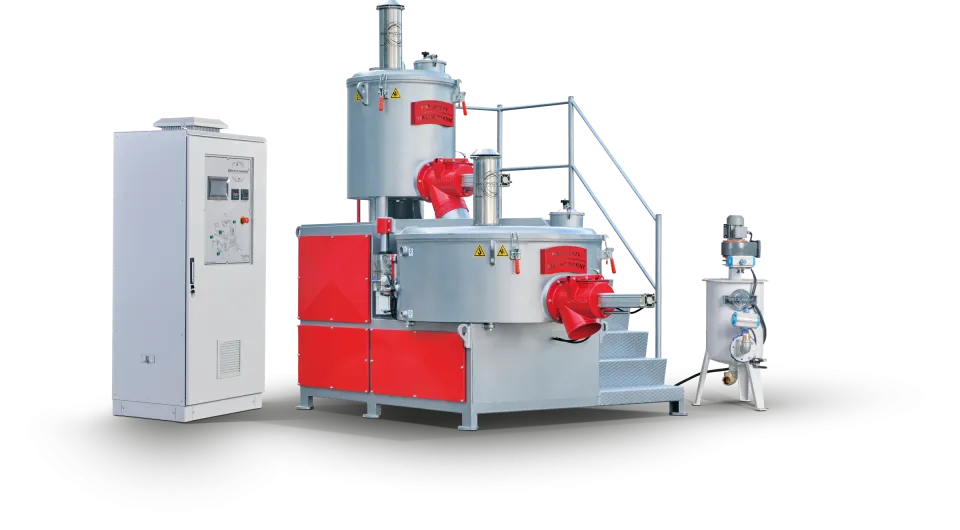 EPM-V
Vertical PVC Turbo Mixer
The EPM-V series pairs a high-speed heater mixer with a vertical cooler mixer: a compact hot/cold turbo mixer for PVC. Three models at…
View -
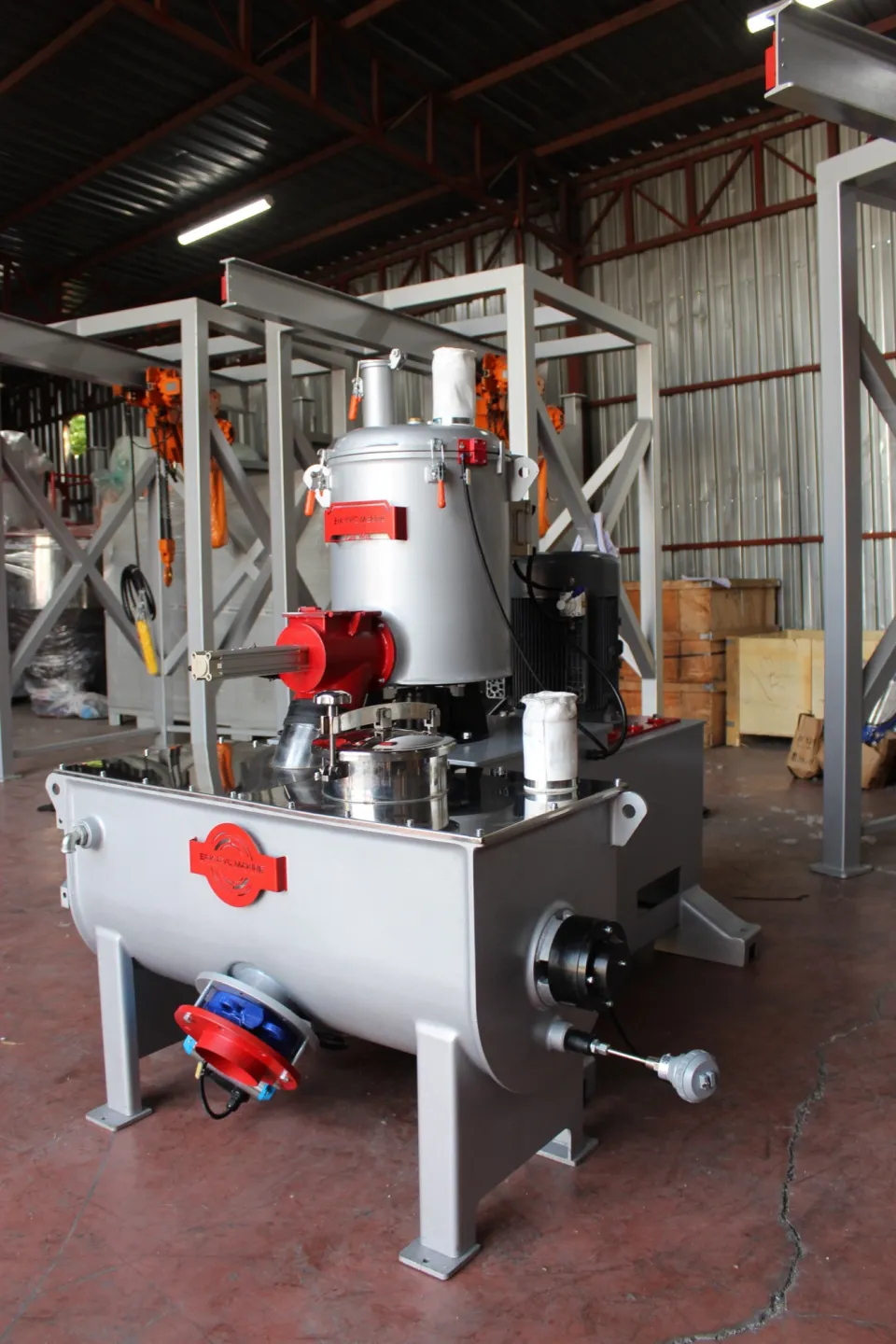
PVC Laboratory Mixer
The EPM laboratory mixer is a low-capacity laboratory heater-cooler mixer for trialling new PVC formulations and alternative raw materials…
View -
Planetary Mixer
In a planetary mixer the agitator spins on its own axis while orbiting the vessel. It is chosen for viscous, paste-like and heavy…
View -
Liquid Dosing System
The automatic gravimetric liquid dosing system weighs plasticisers such as DOP and DOTP, and the liquid stabilisers needed for soft PVC…
View
Quote request
Request a quote for a mixer or mixing system
Share your target capacity and application; our engineers will reply with a quote for the right model and system configuration.
- 01Fill in the form or call us
- 02We clarify your application and capacity
- 03We send a quote with a model and system proposal