Dosing means delivering every component of a recipe to the process in the intended proportion. There are two basic ways to do it: measure the material by volume (volumetric dosing) or measure it by weight (gravimetric dosing). Both are widely used in industry, and each has situations where it is the right tool. This article explains the technical difference between the two, what governs their accuracy and how to decide between them when preparing PVC dry blend. For the effect of gravimetric dosing on recipe consistency specifically, see why gravimetric dosing matters in PVC dry blending.
How volumetric dosing works
A volumetric feeder delivers a set volume per revolution or per unit of time. The most common types are:
- Screw feeders: each turn of the screw moves a roughly constant volume; the dose is set by speed and running time.
- Rotary valve feeders: the pockets of a rotating rotor transfer material in portions.
- Vibratory feeders: material flow is controlled through vibration amplitude and frequency.
The system works on an assumption: this much volume equals this many kilograms. That holds only while the bulk density of the material stays constant. When moisture, compaction, hopper fill level, particle size or a new lot shift the density, the feeder keeps delivering the same volume while the weight delivered changes. A volumetric system cannot detect this on its own.
How gravimetric dosing works
In a gravimetric system the measured quantity is mass. Weighing is done by a hopper or feeder mounted on load cells, and the controller runs the feeder from the weight signal. There are two basic modes:
Batch weighing (gain-in-weight)
Components are fed one after another into a weigh hopper, and each feed stops when its target weight is reached. The completed batch is then transferred to the mixer. Approaching the target with a fast feed and finishing with a fine feed is a common way to improve accuracy on minor ingredients. This is the arrangement most often found ahead of batch-operated heater–cooler mixers.
Loss-in-weight
The feeder and its hopper are weighed together, and the controller watches how fast the hopper loses weight, continuously correcting feeder speed. This method is preferred for continuous processes, such as feeding an extruder directly.
Side-by-side comparison
| Criterion | Volumetric | Gravimetric |
|---|---|---|
| What is measured | Volume (speed, time) | Mass (load cells) |
| Response to density change | Not detected; delivered weight changes | Holds the target weight |
| Calibration | May need resetting for each material or density change | Periodic verification of the weighing system with reference weights |
| Records and traceability | No record of actual weight | Actual weight can be logged per component and batch |
| Complexity | Simpler, fewer components | Requires weighing hardware and control software |
| Typical use | Materials with stable density, wide tolerances | Multi-component recipes, small critical additives |
What affects accuracy
A gravimetric system is not automatically precise just because it weighs. In practice, accuracy depends on:
- Weighing range: weighing a very small additive in a large hopper reduces accuracy. A separate, smaller weigh hopper can be used for minor ingredients.
- Mechanical influences: vibration, rigid pipes or bellows touching the weigh hopper, and air currents can all disturb the reading.
- Material flow: powder that bridges or flows erratically can cause overshoot from material still falling after the feed has stopped.
- Maintenance and verification: load cells and their connections need checking at regular intervals.
Which method for PVC, and when?
PVC formulas are usually written as a few parts of additives per hundred parts of resin, and those minor ingredients govern how the compound behaves. For a multi-component PVC recipe feeding a heater–cooler mixer, a gravimetric system is therefore the common choice. Volumetric dosing makes more sense for single-component transfers of materials with stable density and generous tolerances.
These questions help with the decision:
- How many components does the recipe have, and what is the share of the smallest one?
- How much does raw-material density vary from lot to lot?
- How critical are batch-to-batch consistency and record keeping?
- How often do recipes change?
- Are there liquid components?
In flexible PVC, plasticisers and liquid stabilisers matter too. Because the density of a liquid changes with temperature, measuring liquids by weight also helps consistency.
Erk’s dosing solutions
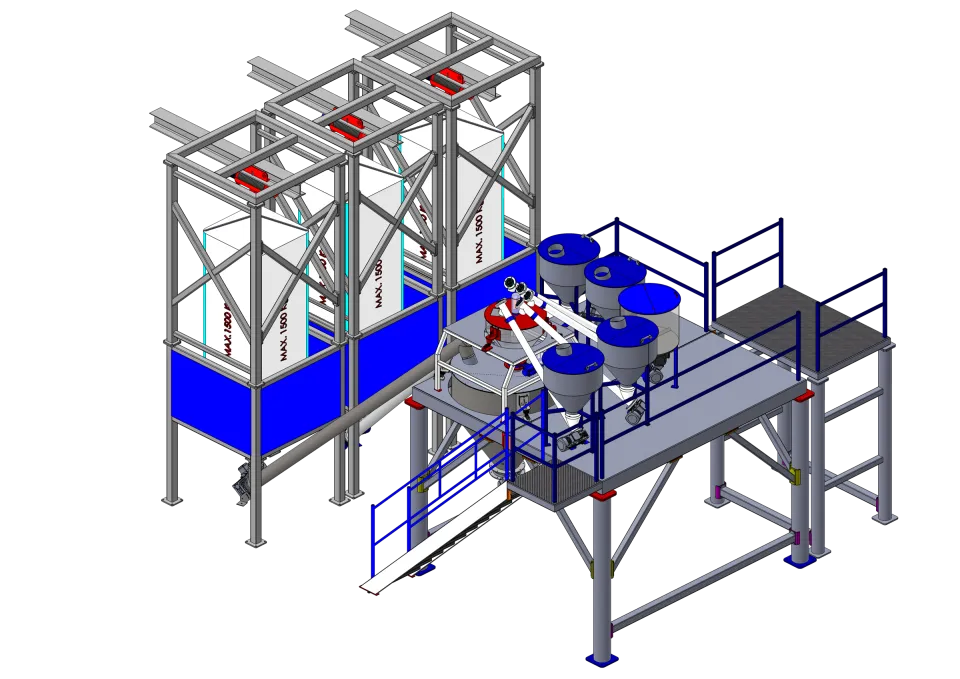
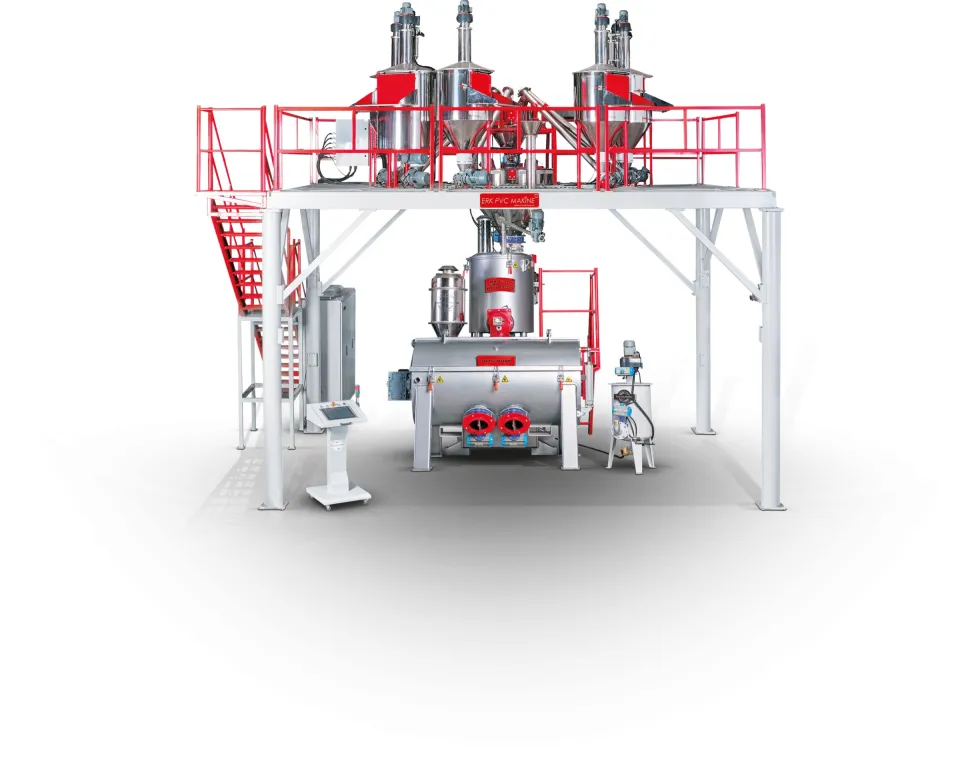
Erk’s automatic gravimetric powder dosing system comes in Model H and Model V layouts; it is computer controlled and weighs the recipe and transfers it to the mixer without manual handling. The automatic liquid dosing system works coupled with powder dosing, so powders and liquids are handled within one recipe. See the dosing systems category for all options. Dosing should be sized together with the batch size and cycle rate of the heater–cooler mixer it feeds; on a line rated at 4–6 batches per hour in the catalogue, the next batch has to be ready on time.
Frequently asked questions
Should volumetric dosing be avoided altogether?
No. For materials with stable density and applications with wide tolerances, volumetric dosing can be a simple, adequate solution. The problem is that density changes go unnoticed.
What is the difference between loss-in-weight and batch weighing?
Batch weighing collects components in a hopper up to their target weights and transfers them as a batch. A loss-in-weight system monitors the hopper’s weight loss to feed continuously.
Can an existing volumetric system be converted to gravimetric?
Usually yes, planned around the layout, the number of components and the connection to the mixer. You can share your component list and batch size on the quote page.